We See This Every Week at TBC — And It’s Getting More Urgent
At TBC Business Consultancy, we work with business owners across Qatar every single day. And over the past few weeks, one question has been coming up more than any other:
“Do I need a licence to sell online?”
The honest answer used to be complicated. Now it isn’t.
Qatar’s Ministry of Commerce and Industry has made it very clear with the release of Ministerial Decision No. 25 of 2026 — if you are selling anything online in Qatar, whether through a website, an Instagram page, a WhatsApp group, or any digital platform, you need a formal Licensing Requirements for E-Commerce in Qatar. No exceptions for small sellers. No grace period for those already operating.
We put together this guide because we believe every business owner in Qatar deserves to understand this law clearly, without legal jargon getting in the way. That’s what TBC is here for.
What Changed and When
On 4 March 2026, Qatar’s Ministry of Commerce and Industry issued Ministerial Decision No. 25 of 2026. The Decision was published in the Official Gazette on 15 March 2026 and entered into force on 16 March 2026.
This is not a proposal. It is not something being planned for the future. It is the law right now, today, as you read this.
For years, online selling in Qatar — particularly through social media — existed in a regulatory grey area. Many of our clients at TBC assumed that because they had no physical shop, the standard business licensing rules did not fully apply to them. That grey area no longer exists. The Ministry has drawn a clear line, and every online seller needs to know which side of it they are on.
Who sets the licensing requirements for e-commerce?
This is the first thing we clarify for every client who comes to TBC with questions about this regulation. The scope is broader than most people expect.
The Decision introduces a mandatory e-commerce licensing regime for certain businesses operating through websites, digital platforms, or social media channels.
Notice that phrase — social media channels. The law was deliberately written to cover the way people actually sell today, not just traditional e-commerce websites. If your business takes orders through Instagram, TikTok, Snapchat, or even a WhatsApp broadcast list, you are operating an electronic platform under this law.
The legal definition is equally broad. An electronic website is defined as any system or technology relying on information technology to facilitate transactions or communication between parties, including social media and online platforms.
The only people genuinely exempt are those making personal transactions conducted through electronic websites, provided they are not in commercial volumes. Selling a second-hand item occasionally? You’re fine. Running a regular operation and generating consistent income from online sales? You are not exempt — and you need to act.
The Rule at the Centre of Everything
When clients sit down with our team at TBC, this is the line we always read out first, because it leaves no room for misinterpretation:
No commercial activity may be conducted through electronic websites without obtaining an e-commerce license from the competent administration and paying the applicable fees.
There is no minimum revenue threshold. There is no exemption for startups or home-based businesses. There is no allowance for sellers who were already operating before the law came into force. If you sell commercially online in Qatar, you need this licence — and TBC can help you get it correctly from the start.
How to Get Your E-Commerce Licence: TBC’s Step-by-Step Breakdown
One of the most common things we hear from business owners is that the licensing process feels overwhelming. At TBC Business Consultancy, we handle this process for our clients every day. Here is exactly how it works.
Step 1 — Commercial Registration First
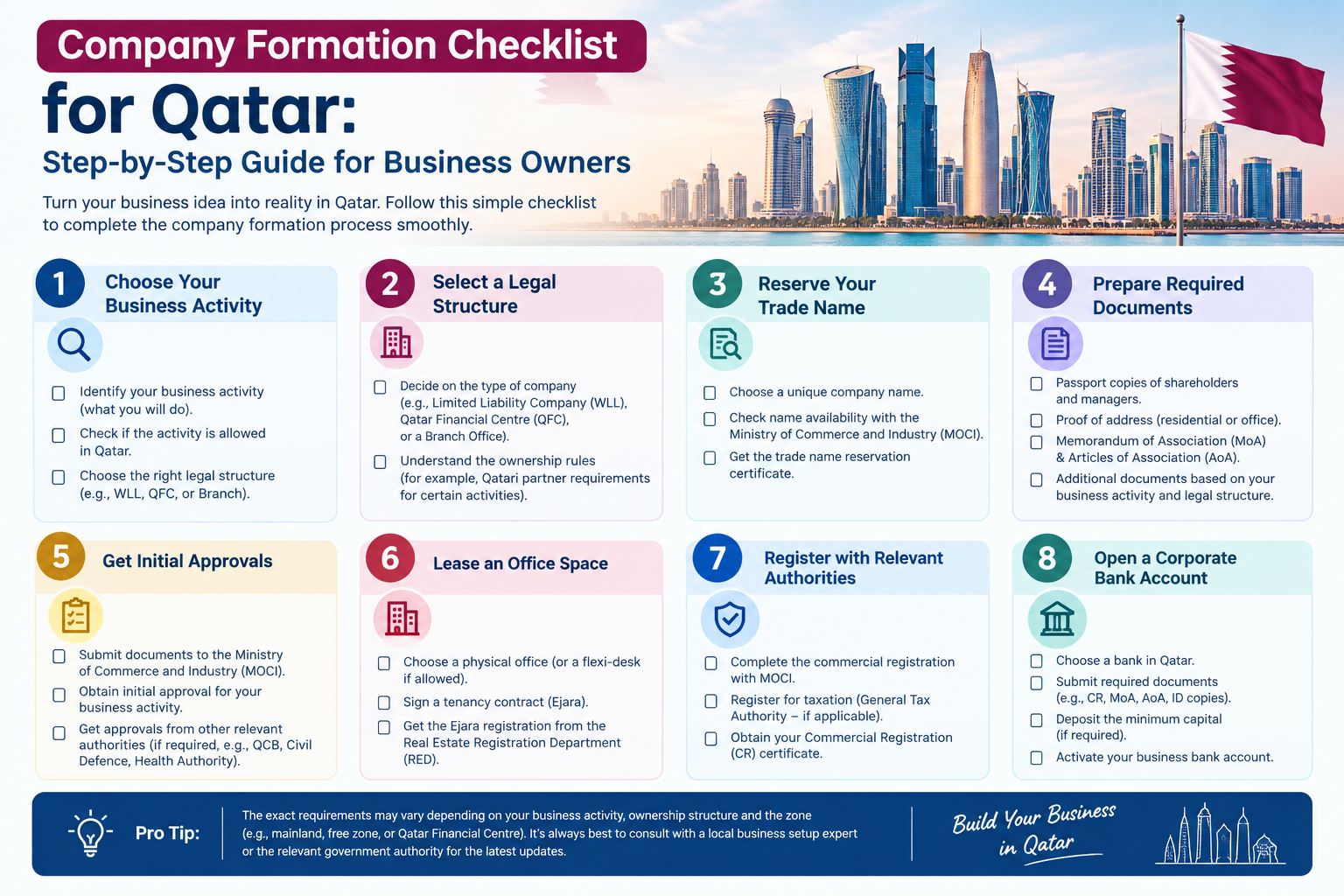
Everything starts here. Applicants must be registered in the commercial register in accordance with applicable laws. Your Commercial Registration, or CR, with the MoCI is the foundation. If you don’t have one, TBC will handle this for you before anything else moves forward.
Step 2 — Define Your Business Activity Clearly
When applying for your e-commerce licence, you must specify exactly what commercial activity you will conduct online. The MoCI maintains an approved list of activities, and your licence will be tied to whichever category fits your business. Being vague or choosing the wrong category can cause delays — something TBC helps clients avoid by getting this right at the application stage.
Step 3 — Secure Any Additional Regulatory Approvals
Depending on what you sell, you may need approvals beyond the e-commerce licence itself. Where applicable, the applicant must obtain any relevant licences or approvals required for the specified commercial activity. Businesses in food, healthcare, financial services, or other regulated sectors need sector-specific sign-off from the relevant authorities. TBC maps out all the approvals your specific business needs before we begin, so nothing is missed.
Step 4 — Identify Your Platform
Applicants must identify the electronic website through which the activity will be conducted. Your specific platform — whether that is your website URL, your Instagram handle, or your marketplace seller account — must be named in the application. This is a detail many first-time applicants overlook.
Step 5 — Submit, Pay, and Get Registered
Once TBC has your application complete and accurate, it is submitted to MoCI along with the applicable fees. Upon approval, your business is added to MoCI’s official register of licensed e-commerce operators. Your licence number is then something you must display publicly — which brings us to the next section.
Selling on Multiple Platforms? This Is Critical
This is one of the most important — and most overlooked — parts of the new regulation. We want every TBC client to understand this before they assume one licence covers everything.
Where a business operates through multiple platforms, a separate licence must be obtained for each platform.
If your business operates a website, an Instagram shop, and a presence on a third-party marketplace, that is three separate licences required. TBC manages multi-platform licence applications regularly, and we make sure nothing falls through the cracks when your business operates across more than one channel.
What Your Platform Must Display to Customers
Getting licensed is only the first part of compliance. The law also sets strict requirements about what information your online platform must openly show to every customer who visits it.
According to the regulation, your platform must clearly display:
Commercial registration and e-commerce licence numbers; contact and customer service details and description of goods or services; and exchange and return policies and procedures, complaint handling, and consumer protection information.
Additionally, electronic platforms must provide electronic payment services for transactions conducted through the platform.
At TBC, when we complete a licensing application for a client, we also conduct a platform compliance review — checking that everything the law requires is visible and correctly presented before you go live or continue operating. A licence alone is not enough if your platform is missing mandatory disclosures.
What If Your Business Is in a Free Zone?
This is a question TBC receives often, and we always give the same careful answer: do not assume you are exempt without checking first.
The decision appears to apply primarily to entities registered with the MoCI. Businesses established under alternative regulatory regimes, such as the Qatar Financial Centre or other free zones, may fall outside the direct scope of the decision. However, this position should be assessed on a case-by-case basis depending on the nature of the activities conducted and the manner in which they are offered within the State of Qatar.
If your business is registered in the QFC or another free zone but you are actively selling to customers inside Qatar, your situation needs to be assessed individually. TBC’s compliance team can review your structure and give you a clear answer on where you stand — before it becomes a problem.
Why This Regulation Is Good for Qatar’s Business Community
At TBC, we understand that new regulations can feel like added pressure, especially for small and growing businesses. But we genuinely believe this framework is a positive development for Qatar’s market.
The Framework should reduce reliance on traditional commercial premises for certain online activities, potentially lowering establishment and operational costs and barriers to entry for digital businesses in Qatar.
In other words, this law makes it easier — not harder — for legitimate online businesses to operate without the expense of a physical shopfront. It creates a fair, transparent marketplace where licensed businesses can compete confidently and consumers can trust the sellers they buy from.
The opportunity is also significant. Qatar’s e-commerce revenue is expected to grow at a compound annual growth rate of 6.9% between 2025 and 2029, reaching a projected market volume of $548.2 million by 2029. Being fully licensed and compliant positions your business to grow with this market — and TBC is here to make sure you are set up correctly to take advantage of it.
Your E-Commerce Compliance Checklist
TBC recommends every online business in Qatar run through this checklist today.
Legal Foundation
- Commercial Registration (CR) completed with MoCI
- E-commerce licence obtained for each platform you sell through
- All sector-specific regulatory approvals secured
- Business registered in MoCI’s official e-commerce operator register
Platform Compliance
- CR number and e-commerce licence number displayed visibly
- Full contact details and customer service information published
- Complete product or service descriptions available
- Clear exchange and return policy stated
- Complaint handling procedure explained
- Electronic payment option integrated and functioning
Ongoing Obligations
- Licence renewal dates tracked and met
- Any changes to platform, activity, or business structure reported to MoCI
- Consumer protection standards maintained at all times
If any item on this list is incomplete, TBC Business Consultancy can help you close the gap quickly and correctly.
TBC’s Advice: Don’t Wait Any Longer
The law has been active since 16 March 2026. In our experience working with businesses across Qatar, regulatory enforcement typically follows within a short window of a new decision coming into force. Businesses that delay compliance are the ones that face disruption — not those who act early.
If you are currently selling online in Qatar without a proper e-commerce licence, or if you are unsure whether your existing setup meets the new requirements, now is the time to find out. TBC Business Consultancy offers a straightforward compliance review where we assess your current status, identify what is needed, and handle the entire licensing process on your behalf.
You focus on running your business. We handle the compliance.
Questions Our Clients Ask Most
1. Do I need a licence if my online sales are small?
If you are selling commercially and generating consistent income, yes — regardless of volume. Only genuine personal transactions at non-commercial scale are exempt.
2. I started selling online before March 2026. Am I covered?
Yes. The law applies from 16 March 2026 regardless of when your business began. Existing sellers must comply now.
3. I sell on my website and on Instagram. Do I need two licences?
Yes. A separate licence is required for each platform you use to sell commercially.
4. Where does TBC fit in this process?
TBC Business Consultancy handles your Commercial Registration, e-commerce licence application, sector approvals, and platform compliance review — everything from start to finish, so you don’t have to navigate it alone.
5. What if I’m registered in a free zone?
Contact TBC for a specific assessment. The answer depends on your activities and how you serve customers inside Qatar.
Ready to Get Licensed? TBC Is Here to Help.
TBC Business Consultancy has been helping businesses set up, grow, and stay compliant in Qatar. E-commerce licensing under Ministerial Decision No. 25 of 2026 is one of the most important compliance steps online businesses in Qatar need to take right now — and we make the process simple, fast, and stress-free.
Get in touch with TBC Business Consultancy today. Let our team review your situation and get your e-commerce licence sorted — the right way, the first time.
 TBC Business Consultancy — Qatar



Leave A Comment