10 August
Uncategorized
What Are the Ongoing Compliance Requirements for Companies in Qatar?
- TBC Qatar
- 0 Comments
Ongoing Compliance Requirements for Companies in Qatar: A Complete 2026 Guide
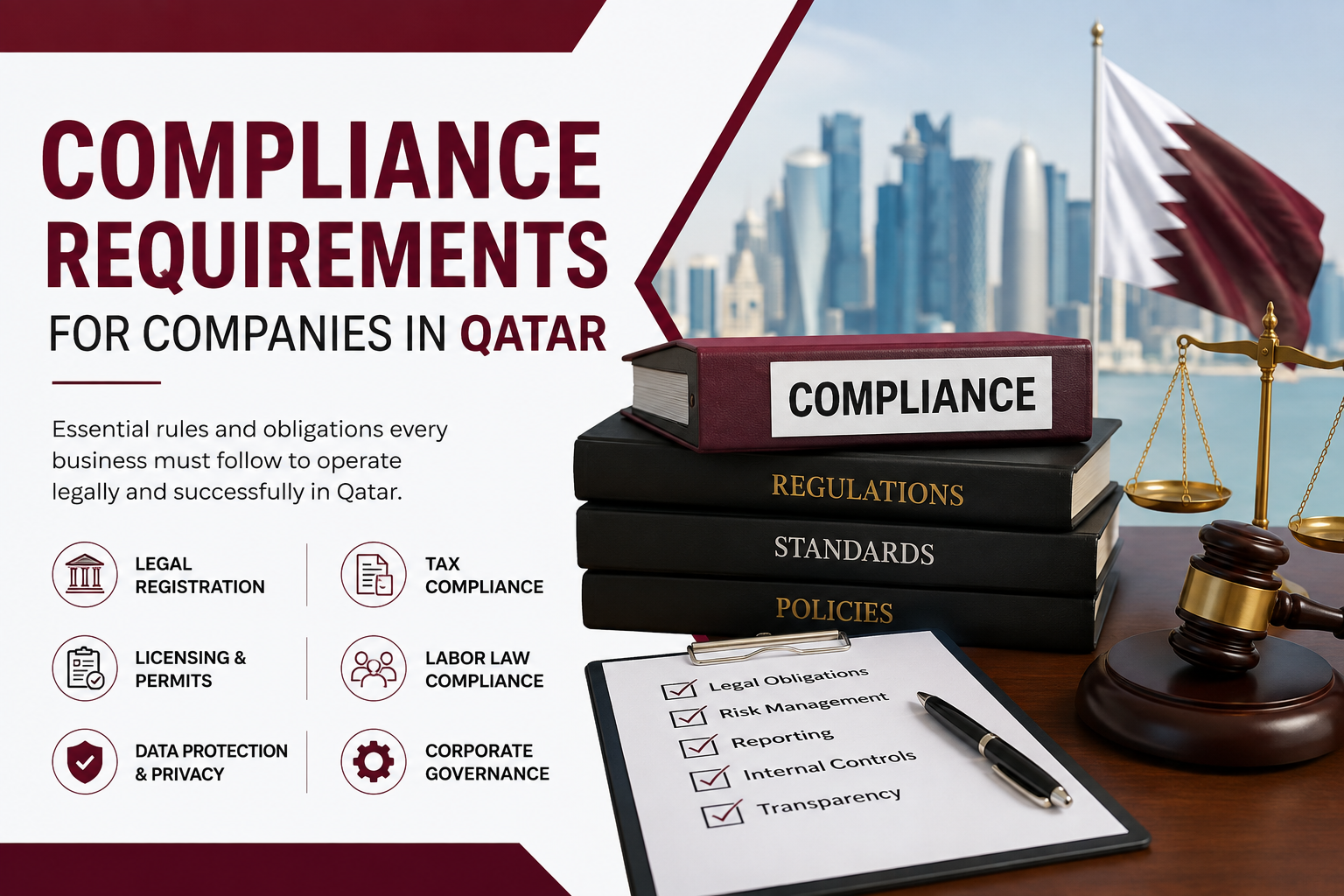
You’ve registered your company in Qatar. You got your commercial certificate. The hard part is over, right?
Not exactly.
What most business owners don’t realize is that company registration in Qatar is just the beginning. The real work—the ongoing compliance requirements that keep your business legal and operational—that’s what happens after you get your CR certificate.
We’ve seen too many companies get blindsided by compliance violations. An HR manager doesn’t realize they missed a labor registration deadline. Finance overlooks a tax filing requirement. A new employee’s visa expires, and suddenly you’re liable for overstay penalties. These aren’t small mistakes—they can result in fines, business suspension, or worse.
Here’s what you actually need to know about keeping your Qatar company compliant, year-round.
Why Compliance Requirements for Companies in Qatar More Than You Think
Before diving into the specifics, understand this: compliance in Qatar isn’t optional bureaucracy. It’s the difference between a thriving business and one that’s constantly fighting Ministry of Labour inspections, tax penalties, and operational shutdowns.
The Ministry of Labour is actively monitoring compliance. They conduct workplace inspections. They audit payroll records. They verify visa registrations. If you’re not compliant, they will find out—and the penalties are steep.
We’ve worked with companies paying QAR 50,000+ in fines for violations that could have been avoided with proper planning. Don’t be that company.
The 5 Core Compliance Areas You Can’t Ignore
1. Wage Protection System (WPS) Compliance
This is non-negotiable. The Wage Protection System is Qatar’s mandatory electronic payroll system, and it’s the single most important compliance requirement for any company with employees.
What WPS requires:
- All employee salaries must be paid through WPS
- Payment must happen between the 1st and 5th of each month
- No cash payments to employees (illegal)
- All deductions must be authorized and documented
- You must register every employee with WPS before their first day
Why this matters: The Ministry of Labour can audit your WPS records at any time. If an employee claims you didn’t pay them on time, WPS creates a digital record. If you’re not compliant, the burden of proof falls on you to show you paid them—and paper receipts don’t count.
What we see go wrong: Companies think they can register employees with WPS whenever they want. They can’t. Registration must happen before employment starts. We’ve had clients get fined QAR 10,000+ because they registered an employee a week late.
2. Employment Contracts & Labour Law Compliance
Every employee must have a written employment contract compliant with Qatar Labour Law. This isn’t just paperwork—it’s your legal protection.
Critical contract requirements:
- Contract must be in Arabic (primary) and the employee’s language
- Must specify job title, salary, benefits, working hours
- Must include probation period (if applicable)
- Must address termination conditions
- Must comply with Qatar’s minimum wage (if applicable)
Why this matters: If an employment dispute arises, your contract is your evidence. A poorly written contract leaves you vulnerable to claims you never intended to make.
Timeline: Contracts must be registered with Ministry of Labour within 30 days of employment start. Missing this deadline creates liability.
3. Ministry of Labour Registrations & Renewals
Your relationship with the Ministry of Labour doesn’t end at registration. It’s ongoing.
Annual/Periodic requirements:
- Work Permits: Renew annually (or per contract term)
- Residency Visas: Renew before expiration (typically 2-3 years)
- Establishment Registration: Renew annually
- Workplace Inspection Compliance: Pass regular inspections
The timeline problem: Ministry of Labour processes work slowly. A renewal that should take 2 weeks can take 4-6 weeks if paperwork is incomplete. If your employee’s visa expires while you’re waiting for renewal, you’re liable for overstay penalties.
What we recommend: Start renewal processes 6-8 weeks before expiration dates. Don’t wait until the last month.
4. General Tax Authority (GTA) Compliance
If your company earns income, you have tax obligations. Period.
Tax requirements:
- Corporate Income Tax: 10% on net profits (for foreign-owned companies)
- Annual Tax Return: File by end of March following the fiscal year
- VAT (if applicable): Some businesses must register for VAT
- Record Keeping: Maintain financial records for 5 years minimum
Why this matters: The General Tax Authority is increasingly active. They’re auditing companies. They’re catching businesses that underreport income. The penalties are substantial—and they compound if you’re late.
Critical date: Tax returns due March 31st for the previous calendar year. Missing this deadline triggers fines and interest.
5. Commercial License & Business Activity Compliance
Your commercial license isn’t permanent. It requires renewal and compliance verification.
Renewal requirements:
- Annual/Bi-annual renewal (depends on your license type)
- Proof of business address (sometimes requires site inspection)
- Proof of ongoing business activity (financial statements, client contracts)
- Compliance with approved activities (you can only operate in approved sectors)
The activity trap: Your commercial license specifies exactly what business activities you’re authorized to conduct. If you operate outside those activities, you’re in violation. Expanding into a new service? You need license amendment approval first.
The Timeline That Matters
Most compliance violations happen because business owners don’t know the deadlines. Here’s your calendar:
Deadline | Requirement | Consequence of Missing |
Before hiring | WPS registration | QAR 5,000-10,000 fine per employee |
Month 1-12 | Monthly WPS payroll | Employee claims + audit liability |
30 days after hire | Ministry of Labour contract registration | QAR 2,000-5,000 fine |
Before expiration | Visa renewal (typically 2-3 years before) | Overstay penalties QAR 100+/day |
Before expiration | Work permit renewal (annual) | Business suspension risk |
March 31 | Tax return filing | Penalties + interest on late filing |
Annually | Commercial license renewal | License suspension |
Quarterly | Workplace safety compliance checks | Fines if violations found |
Common Compliance Mistakes We See
Mistake #1: Thinking PRO Services Are Optional
Companies think: “We can handle this ourselves. How hard can it be?”
Reality: Ministry of Labour processes are specific. Paperwork must be submitted in exact formats. Deadlines matter. One missing document delays everything by weeks. One missed deadline creates liability.
We’ve seen companies attempt DIY compliance, miss a deadline, and then spend QAR 20,000+ in fines trying to fix it.
Mistake #2: Delaying Renewals
Companies think: “The renewal isn’t due for 3 months. We’ll handle it then.”
Reality: Government offices are slow. A “simple” renewal can take 4-6 weeks. If you wait until the last month, expiration happens before approval.
Mistake #3: Not Updating Contracts
Companies think: “We used the same contract for 5 years. It’s fine.”
Reality: Qatar Labour Law changes. What was compliant in 2023 might violate 2026 requirements. Outdated contracts leave you vulnerable.
Mistake #4: Underreporting Income for Taxes
Companies think: “If we report lower income, we pay less tax.”
Reality: Tax audits happen. When they find the discrepancy, penalties compound. You owe back taxes plus fines plus interest—often 30-50% more than the original tax owed.
How to Stay Compliant Without Constant Stress
Build a system. Create a calendar with all your compliance deadlines. Assign someone (ideally a PRO service, but at minimum someone on your team) to own each deadline.
Get professional help. A PRO service knows the system. They file renewals on time. They know which departments move fast and which are slow. They know how to navigate around bottlenecks.
Document everything. Keep records of every filing, every approval, every communication with government offices. If there’s ever a dispute, documentation is your proof.
Review quarterly. Once per quarter, check: Are all employees properly registered with WPS? Are visa expiration dates tracked? Is tax compliance on schedule? Small reviews prevent big surprises.
The Real Cost of Non-Compliance
Let me be direct: non-compliance isn’t just about fines. It’s about business interruption.
An employee’s visa expires? They can’t work. Your operations suffer.
A Ministry inspection finds violations? They can suspend your license pending remediation.
A tax audit uncovers discrepancies? You’re spending months with accountants and government officials instead of running your business.
The cost of one serious compliance violation often exceeds the cost of a full year of professional PRO services.
How TBC QA Keeps You Compliant
At TBC QA, we’ve been managing compliance for dozens of companies. Here’s what we do:
Proactive tracking: We maintain a compliance calendar for your company. We track every renewal date, every filing deadline, every registration requirement.
Timely submissions: We submit renewals and filings on time—not the day before expiration, but weeks in advance to account for government processing delays.
Ministry relationships: We know the people at the Ministry of Labour. We know which departments move fast and which need extra coordination. We leverage those relationships to expedite approvals.
Documentation: We keep detailed records of every submission, every approval, every communication. If there’s ever a question, we have proof.
Updates: Qatar’s regulations change. We stay current on changes and make sure your company is always compliant with the latest requirements.
Cost: Our compliance services cost a fraction of what one serious violation costs in fines and business disruption.
Your Action Items
- Audit your current status: Check when your last tax return was filed. When do your work permits expire? Is your WPS registration current?
- Create a compliance calendar: List every deadline for the next 12 months.
- Review your contracts: Are your employment contracts compliant with current Qatar Labour Law?
- Get professional help: Don’t try to manage this alone. Hire a PRO service or at minimum have a lawyer review your compliance position.
- Plan for next year: Compliance isn’t a crisis—it’s a rhythm. Build it into your business cycle.
The Bottom Line
Compliance in Qatar isn’t complicated, but it is unforgiving. Miss a deadline, and you face fines. Violate a regulation, and your business suffers.
The companies that thrive in Qatar are the ones that treat compliance as a business priority, not an afterthought. They build systems. They get professional help. They stay ahead of deadlines.
That’s the difference between a company that runs smoothly and one that’s constantly fighting government agencies.
Ready to get your compliance strategy in order? TBC QA can audit your current status, identify gaps, and put you on a compliant path. [Schedule a free compliance consultation →]https://tbcqa.com/contact-us
We’ll review your registrations, contracts, tax filings, and employment records. Then we’ll tell you exactly what needs attention and how to fix it.





Leave A Comment