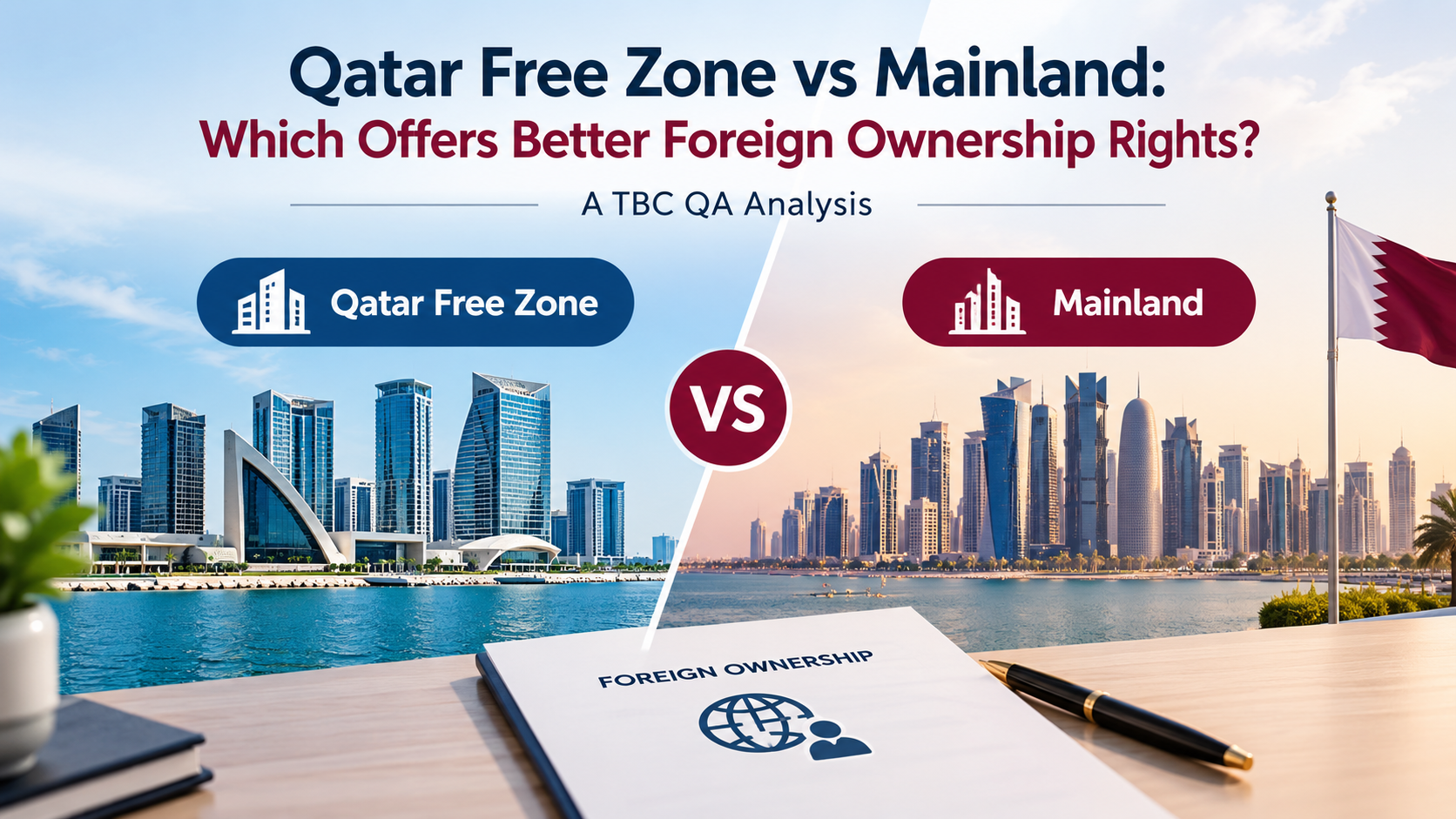
One of the first decisions we help business owners make at TBC QA is simple but critical: should you establish your company in a Qatar free zone or on the mainland?
On the surface, it seems like a straightforward choice. But the reality is more nuanced.
We’ve worked with companies that chose the wrong option and regretted it for years. We’ve also worked with companies that carefully evaluated both options and made strategic decisions that positioned them perfectly for growth.
The difference between these two groups? Understanding what each option actually offers—especially when it comes to foreign ownership rights.
Let’s break this down honestly, because the marketing materials from free zone authorities tell one story, and the practical reality tells another.
The Quick Answer (Then We’ll Explain)
If you want maximum foreign ownership flexibility and the lowest operational costs, a mainland LLC is usually your best choice in 2026.
If you’re in specific industries (manufacturing, logistics, tech), plan to export heavily, or want maximum tax benefits, a free zone might make sense.
But the real answer depends on your specific business model, growth plans, and operational needs. Let’s walk through the factors that actually matter.
Understanding Foreign Ownership in Qatar
First, context: Qatar changed its foreign ownership rules a few years ago. This was a major shift.
Previously, foreign investors could own maximum 49% of a business. A Qatari national had to own at least 51%. This was the rule for decades.
Then Qatar modernized its investment laws. Foreign investors can now own 100% of their company in most sectors—if they choose the right structure and meet the requirements.
This is huge. It’s also where confusion happens.
Mainland Companies: The Most Flexible Option
How Mainland Foreign Ownership Works
On the mainland (registered with MOCI—Ministry of Commerce and Industry), foreign investors can own 100% of an LLC or sole proprietorship in most business sectors.
This includes: consulting, professional services, trading, import/export, technology, hospitality, healthcare, education, retail, and dozens of other sectors.
You don’t need a Qatari partner. You don’t need to negotiate ownership percentages. You can be the sole owner if you want.
The Catch (Because There’s Always a Catch)
100% foreign ownership on the mainland requires a “foreign business license” and approval from specific government authorities depending on your sector.
For most sectors, this approval is automatic. File the application, pay the fees, get approval. Simple.
For some sectors—primarily those involving strategic industries—approval requires Ministry sign-off and can take longer.
Mainland Foreign Ownership: The Practical Reality
In our experience working with 200+ mainland companies, foreign ownership approval is straightforward for the majority of business types.
We’ve seen rejections, but they’re rare and usually because:
- The business involves restricted sectors (certain defense-related, telecom, energy)
- The applicant has documentation issues
- The application was submitted incompletely
For legitimate business purposes with proper documentation, mainstream business sectors get approved for 100% foreign ownership on the mainland.
The Operational Cost of Mainland
Monthly operational requirements:
- WPS payroll system: Mandatory for employees
- Ministry of Labour registrations: Work permits, visa sponsorships
- Annual license renewal: Required
- Tax compliance: 10% corporate income tax on profits
- Workplace inspections: Periodic Ministry of Labour checks
Mainland companies face more regulatory oversight because they’re operating in the general market. But that oversight keeps you honest and protected.
Free Zones: Maximum Tax Benefits, Specific Use Cases
How Free Zone Foreign Ownership Works
Free zones (like QFZA—Qatar Free Zones Authority, QSTP—Qatar Science and Technology Park, Industrial Zone Qatar) allow 100% foreign ownership for companies operating in designated activities.
The key phrase: “designated activities.”
Each free zone has a list of approved business activities. Manufacturing, logistics, warehousing, technology development, call centers, specialized services. These are the activities that get 100% foreign ownership approval.
If your business falls within those designated activities, you get 100% ownership plus significant tax and operational benefits.
The Real Benefits of Free Zones
Tax advantages: 100% corporate tax exemption (for up to 20 years in some zones). That’s massive compared to mainland’s 10% tax.
Customs benefits: Imports/exports through the zone face zero customs duties (in most cases). If you’re importing goods to manufacture or distribute, this saves money.
Operational simplicity: Fewer workplace inspection requirements compared to mainland. Less regulatory oversight.
Business model fit: If you’re manufacturing, logistics, or tech development, free zones are optimized for your operations.
The Significant Catch
Free zones are beneficial if your business is on their approved activity list.
Here’s what we see go wrong: A business owner thinks, “I’ll establish in a free zone for the tax benefits.” They apply to set up a consulting practice in the free zone. Consulting isn’t on the approved activities list. Approval denied.
Or worse: They somehow get approved for an activity that’s not actually their primary business. Now they’re operating outside their approved scope. That’s a compliance violation.
Free Zone Operations: More Complex Than It Looks
Free zones sound simpler (fewer inspections, no WPS requirements for certain zones, lower tax). But they’re actually more operationally complex:
- You need office space inside the free zone (you can’t operate from home or an external location)
- Business activities must match your approved scope exactly
- Transferring goods in/out of the zone requires customs documentation
- Visa sponsorship processes can be different than mainland
- If you need to sell to mainland Qatar, you need to set up additional structures or face restrictions
We’ve worked with free zone companies that thought they’d set up simply and found themselves dealing with unexpected regulatory requirements. The “simplicity” of free zones is overstated.
The Direct Comparison: Foreign Ownership Rights
Here’s where business owners get confused, so let’s be clear:
Mainland (MOCI Registration)
 Foreign ownership: 100% in most sectors (approved through Ministry of Commerce)
Approval timeline: 2-4 weeks (most cases)
Scope flexibility: Can operate from anywhere in Qatar (office, home, co-working space)
Activity changes: Can request amendments to approved activities (approval usually granted)
Employee structure: Full WPS compliance required (actually protects you and employees)
Tax rate: 10% corporate income tax (standard for foreign-owned companies)
Best for: Consulting, professional services, trading, tech, retail, most service businesses
Free Zones (QFZA, QSTP, etc.)
Foreign ownership: 100% (if your activity is on approved list)
 Approval timeline: 2-6 weeks (longer if activity requires special review)
Scope flexibility: Must operate from designated free zone space
Activity changes: Limited flexibility; adding activities requires new approvals
Employee structure: Reduced WPS requirements (varies by zone)
Tax rate: 0-10% corporate income tax (often 0% for first 10-20 years)
Best for: Manufacturing, logistics, tech development, export-focused businesses
When Each Option Makes Sense
Choose Mainland If:
You’re establishing a consulting practice, professional services firm, trading company, or service business. These are the bread-and-butter businesses in Qatar, and mainland registration is perfect for them.
You want maximum flexibility in where you operate from and what you actually do. The mainland allows you to evolve your business without requesting activity amendments.
You want to hire employees with standard WPS protection. This actually benefits both you and your staff.
You want to serve both mainland and export markets without complex logistics structures.
You’re uncertain about your exact business scope and want room to expand. Mainland allows amendment requests.
Choose Free Zone If:
You’re manufacturing or producing goods. Free zone infrastructure is designed for this.
You’re a logistics or warehousing company. Free zones were built for this business model.
You’re heavily focused on export markets. Free zone customs benefits matter for your economics.
You’re in technology development or specific tech services. QSTP specifically supports this.
You’ve calculated that the tax savings over your planned business timeline significantly exceed mainland costs. (Sometimes they do, sometimes they don’t—run the math.)
The Financial Reality (Not the Marketing Pitch)
Let’s run actual numbers for a hypothetical consulting company:
Mainland Consulting Company (QAR 500K annual revenue):
- Annual license renewal: QAR 1,500
- PRO services: QAR 4,000
- Corporate income tax (10% on net profit): ~QAR 20,000-30,000 (depending on margins)
- Payroll/WPS compliance: Built into HR costs
- Total annual cost: ~QAR 25,500-35,500
Free Zone Consulting Company (QAR 500K revenue):
- Consulting isn’t approved in most free zones
- You can’t actually do this
Now for a manufacturing company (QAR 500K revenue):
Mainland Manufacturing:
- License renewal: QAR 2,000
- PRO services: QAR 6,000
- Corporate income tax (10%): ~QAR 20,000-30,000
- Customs duties on imports: ~QAR 10,000-20,000 (depending on goods)
- Total annual cost: ~QAR 38,000-58,000
Free Zone Manufacturing (QFZA):
- Free zone office space: QAR 3,000-5,000/month (QAR 36,000-60,000/year)
- License renewal: QAR 1,000
- PRO services: QAR 3,000
- Corporate income tax: QAR 0-5,000 (often exempted first 10-20 years)
- Customs duties: QAR 0 (exempted in free zone)
- Total annual cost: ~QAR 40,000-69,000
In this case, free zone is slightly more expensive due to office space, but the tax exemption saves money over time. For manufacturing specifically, free zone makes economic sense.
For consulting? Mainland is dramatically cheaper.
What We Recommend at TBC QA
After working with 400+ companies, here’s our general guidance:
For 80% of businesses: Mainland registration is the right choice. It’s simpler, more flexible, and more cost-effective for non-manufacturing, non-export-heavy businesses.
For 15% of businesses: Free zone registration makes sense if you’re manufacturing, logistics-focused, or heavily export-oriented, and you’ve calculated the tax savings.
For 5% of businesses: A hybrid approach makes sense—mainland registration for your core business plus a free zone entity for specific manufacturing or export operations.
The key is doing the analysis. Run the numbers for your specific business model. Don’t assume free zones are cheaper—for most service businesses, they’re not.
The Foreign Ownership Question: Final Answer
Both mainland and free zones offer 100% foreign ownership for most legitimate business activities.
The real question isn’t “which offers better foreign ownership” (they’re equal on that front). It’s “which is better for my specific business model, location needs, and financial situation?”
For that answer, you need to evaluate:
- Your specific business activity
- Whether that activity is approved in your preferred free zone
- The space/location requirements of your business
- Your 5-year financial projections
- Your operational flexibility needs
- Your risk tolerance around regulatory oversight
That’s the analysis we do with every client at TBC QA. And 80% of the time, we recommend mainland.
Ready to Make the Right Decision?
Choosing between mainland and free zone is one of the most important decisions you’ll make for your Qatar business. Get it wrong, and you’ll be dealing with it for years.
At TBC QA, we help business owners evaluate both options, run financial projections, and make strategic decisions based on their actual business model—not marketing hype.
[Schedule your free consultation →]
We’ll review your specific business, evaluate both options, run the financial analysis, and recommend the structure that makes the most sense for your situation.
No pressure. No bias toward one option or the other. Just honest analysis of what works best for your business.




Leave A Comment