Company Formation Checklist for Qatar: Step-by-Step Guide for Business Owners
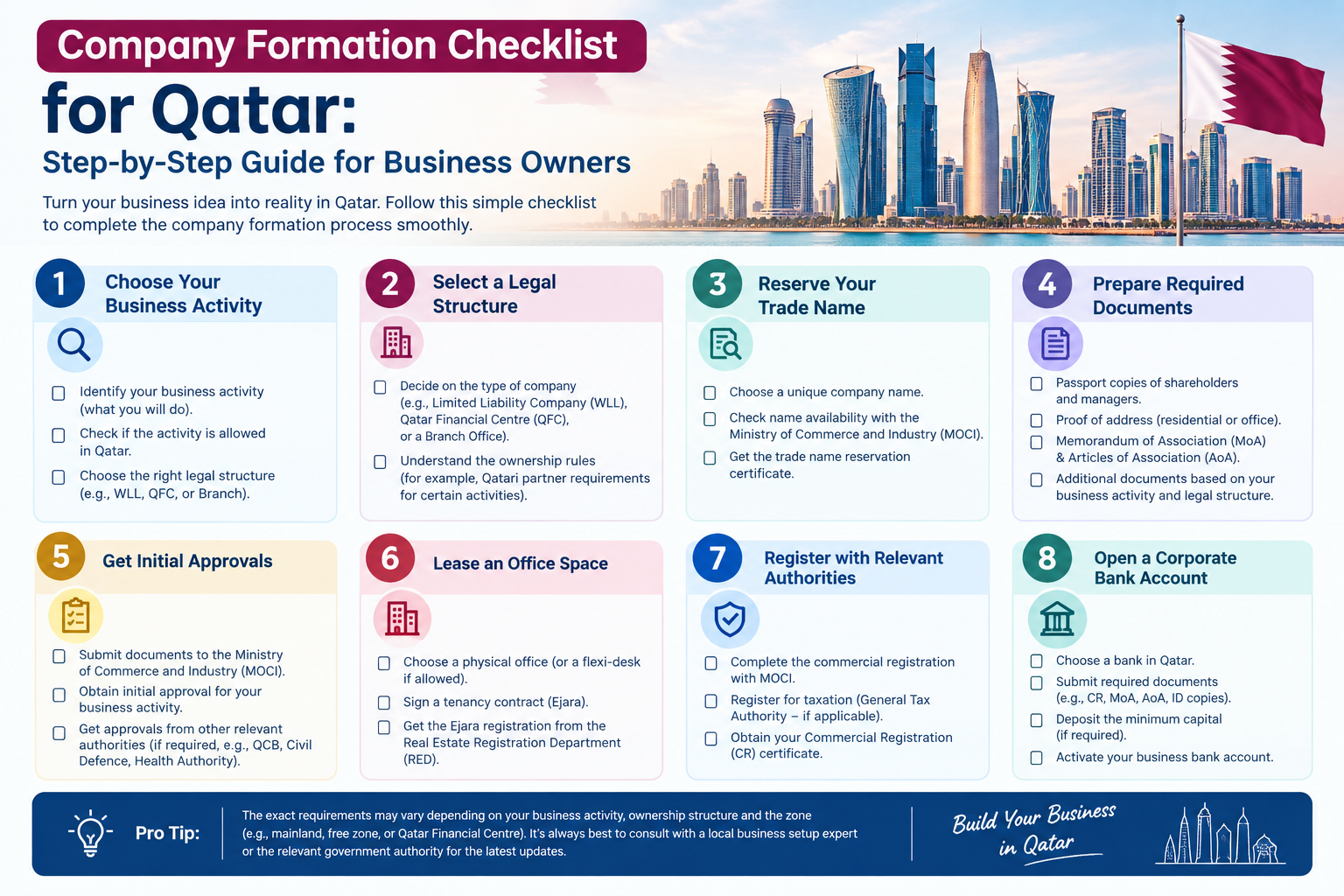
Setting up a company in Qatar is very doable. The problem is that it is easy to start in the wrong order, buy a lease before checking your activity, or sign documents before the structure is clear.
This company formation checklist for Qatar puts the steps in a sensible order. You will see what to decide first, what to prepare, which authorities are involved and what to do once your company is registered.
Rules and fees change, so we point you to the official source wherever it matters. Use this as your roadmap, then confirm the details for your case.
Before You Start: Five Questions to Answer First
Spending an hour on these now can save weeks later.
- What exactly will the company do? Your business activity decides your licence, permits and sometimes your structure.
- Who will own it? Individual or corporate owners, local or foreign, and in what percentages.
- Where will it operate? Mainland Qatar, a free zone or the Qatar Financial Centre (QFC).
- How much money do you need? Include setup costs, rent, salaries and at least a few months of running costs.
- Who will manage it? Qatar requires named managers and authorised signatories.
Step 1: Choose Your Company Structure
Pick the structure that fits your goals. Common options include:
Structure | Best for |
Limited Liability Company (LLC) | Most small and medium businesses, including foreign-owned ones where permitted |
Sole proprietorship | Individual business owners, usually Qatari nationals |
Branch of a foreign company | Foreign companies expanding their existing business |
Representative office | Marketing and liaison only, not trading |
Free zone company | Businesses that qualify for free zone activities and incentives |
QFC company | Financial, professional and certain business services |
Foreign ownership rules have been relaxed in recent years, and many sectors now allow higher foreign ownership. Some activities still need special approval. Confirm the current position for your activity before you commit.
Step 2: Check Your Business Activity and Required Approvals
Find out exactly which activity code your business falls under, and whether it needs extra approvals. Examples include food and catering, healthcare, education, construction, advertising, and trading in regulated goods.
Checklist:
- [ ] Activity name and code confirmed
- [ ] Any special permits identified
- [ ] Foreign ownership allowance checked for this activity
- [ ] Location restrictions checked (for example, certain activities are limited to specific zones)
Step 3: Reserve and Register Your Company Name
Your trade name must follow the naming rules and not duplicate an existing one.
Checklist:
- [ ] Choose two or three name options in case your first is taken
- [ ] Check that the name suits your activity and has no restricted words
- [ ] Submit the name for approval through the official channel
- [ ] Keep the approval record
Step 4: Prepare the Founding Documents
Documents depend on your structure, but most applications involve:
For individual shareholders
- [ ] Passport copies (and Qatar ID if resident)
- [ ] Passport-size photographs
- [ ] Proof of address where requested
- [ ] Power of attorney, if someone signs on your behalf
For corporate shareholders
- [ ] Certificate of incorporation and constitutional documents
- [ ] Board resolution approving the investment
- [ ] Authorised signatory details
- [ ] Attestation and legalisation of foreign documents, as required, with translation into Arabic where needed
For the company
- [ ] Memorandum and Articles of Association
- [ ] Shareholder and manager details
- [ ] Capital details
Foreign documents often take the longest because they need attestation. Start this early.
Step 5: Secure Your Office Space
Most companies need a registered business address. You will normally need a tenancy or lease contract that suits your licensed activity and meets the authorities’ requirements.
Checklist:
- [ ] Confirm the property is allowed for your business activity
- [ ] Sign the lease only after checking it will be accepted for licensing
- [ ] Register or authenticate the lease as required
- [ ] Keep copies for your licensing and establishment card applications
A common mistake is signing a long lease before confirming that it works for your licence. Check first.
Step 6: Sign the Articles of Association and Register With the Authorities
Once documents are ready, the company is formally registered. This involves the Ministry of Commerce and Industry and, depending on the case, other bodies such as the Ministry of Municipality.
Checklist:
- [ ] Articles of Association signed and authenticated
- [ ] Commercial registration (CR) issued
- [ ] Trade licence issued
- [ ] Chamber of Commerce registration completed where required
- [ ] Approvals from other authorities obtained for your activity
Step 7: Complete Your Post-Registration Setup
Registration is not the finish line. Complete these before you operate.
Checklist:
- [ ] Establishment card obtained
- [ ] Ministry of Labour account created for hiring
- [ ] Ministry of Interior account set up for visas and residence
- [ ] Tax registration with the General Tax Authority
- [ ] Corporate bank account opened and capital deposited if required
- [ ] Civil Defence and safety approvals for premises, where needed
- [ ] Company seal and stationery prepared
- [ ] Insurance arranged where required or advisable
Step 8: Prepare to Hire and Stay Compliant
When you are ready to build a team, you will need visa quota, contracts and residence permits. Read our guide on the employment visa process in Qatar before you plan start dates.
Then put your compliance calendar in place. Our business compliance guide for Qatar explains renewals, tax filings and labour obligations to track from day one.
Quick Master Checklist
Print this and tick as you go.
- [ ] Business idea and activity defined
- [ ] Feasibility and budget reviewed
- [ ] Ownership structure chosen
- [ ] Mainland, free zone or QFC decided
- [ ] Special approvals identified
- [ ] Company name approved
- [ ] Shareholder and company documents prepared and attested
- [ ] Office lease secured and accepted
- [ ] Articles of Association signed
- [ ] Commercial registration and trade licence issued
- [ ] Establishment card obtained
- [ ] Labour and Interior accounts active
- [ ] Tax registration completed
- [ ] Bank account opened
- [ ] Insurance and safety approvals in place
- [ ] Compliance calendar created
Mainland vs Free Zone vs QFC: A Quick Comparison
Mainland | Free zone | QFC | |
Where you can trade | Across Qatar | Mainly within the zone or for export, depending on rules | Financial and related professional services |
Typical fit | Retail, services, contracting | Logistics, technology, trade | Banking, advisory, insurance, funds |
Rules and approvals | Ministry of Commerce and Industry and related bodies | Free zone authority | Qatar Financial Centre Authority |
Each option has different requirements and benefits. Choose based on your activity and customers, not just the setup cost.
Common Company Formation Mistakes in Qatar
- Choosing the structure before the activity. Start with what you will do.
- Signing the lease too early. Confirm it will be accepted for your licence.
- Delaying document attestation. Foreign paperwork can add weeks.
- Underestimating working capital. The first months usually cost more than expected.
- Wrong or too many activities. Your licence should match what you actually do.
- Forgetting post-registration steps. The tax registration, labour account and bank account matter.
- Planning hires too late. Visas and approvals take time.
- Using old information. Always confirm current rules.
How TBC Business Consultancy Qatar Can Help
You can complete company formation yourself, but a well-organised process saves time and avoids rework. With us you get:
- A checklist tailored to your structure and activity
- Advice on mainland, free zone or QFC options
- Document review before submission
- Support with government portals and follow-up
- Help with licences, accounts and post-registration setup
- Ongoing compliance and visa support once you are running
We do not promise approvals or timelines we cannot control, but we make sure your application is complete and submitted correctly.
Frequently Asked Questions
How do I start a company in Qatar?
Decide your activity, structure and ownership. Then reserve a name, prepare documents, secure an office, register with the authorities, and complete post-registration steps like the establishment card, tax registration and bank account.
How long does company formation take in Qatar?
It varies with the structure, activity and how quickly documents are ready. Foreign document attestation and special approvals are the most common causes of delay. A consultant can give you a realistic estimate after reviewing your case.
Can a foreigner own 100% of a company in Qatar?
In many sectors, foreign investors can now own up to 100% of a company, but some activities have restrictions or require approval. Confirm the rules for your activity.
How much capital do I need to start a company in Qatar?
It depends on your activity, structure and the requirements of the authorities. Plan for registration costs, lease, staff, equipment and several months of operating expenses.
What documents are needed to register a company in Qatar?
Usually passports or corporate documents for the owners, Articles of Association, a lease agreement, name approval and any activity-specific permits. Foreign documents may need attestation.
Do I need a local office to register a company?
In most cases, yes. You need a suitable registered address that is accepted for your licensed activity.
What is the difference between a mainland and a free zone company?
A mainland company can generally trade across Qatar. A free zone company operates under its zone’s rules and may have limits on local trading. The right choice depends on your customers and activity.
Can I hire employees right after registration?
You can after your establishment card and government accounts are active and you have the approvals needed for visas. See our employment visa guide for the steps.


Leave A Comment